简介
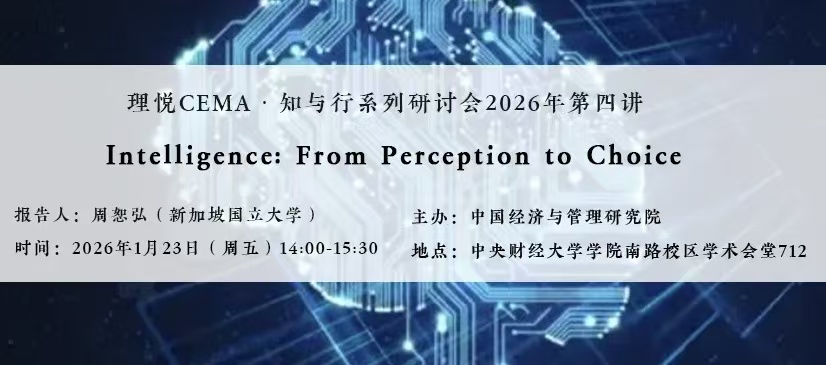
理悦CEMA•知与行系列研讨会2026年第四讲将于1月23日(周五)下午14:00-15:30在学术会堂712会议室举行,由西南财经大学智慧经济科学研究中心主任,新加坡国立大学经济系讲席教授周恕弘教授报告人脑是如何做决策的微观经济学深层的研究:“Intelligence: From Perception to Choice”(智慧:从感知到抉择)。欢迎广大师生(尤其是对科研有兴趣和追求的本科生、硕士生和博士生)参加,讲座结束后周教授愿意给个discussion session(讨论环节)。讲座前后周教授或许给大家弹弹712的三角钢琴。
题目
Intelligence: From Perception to Choice
智慧:从感知到抉择
报告人
周恕弘
西南财经大学智慧经济科学研究中心主任,新加坡国立大学经济系讲席教授。现为世界计量经济学会会士(Econometric Society,Fellow)和经济学理论促进学会会士(SAET Fellow), 是行为和实验学的国际领军人物。他1981年毕业于不列颠哥伦比亚大学。在 国际顶尖的top five 中的Econometrica(4篇),Journal of Political Economy, Review of Economic Studies, 以及国际顶尖的Journal of European Economic Association, International Economic Review(2篇), Journal of Economic Theory(13篇), Management Science等发表诸多论文。他同时也在有关生物学的重要学刊发表了许多论文, 如Proceedings of the National Academy of Sciences (PNAS), Neuron, Proceedings of the Royal Society Series B Behavioral and Brain Sciences以及Neuroimage等。
摘要
A choice situation involves an interplay between the decision maker and her environment from which she senses affordances and perceives options or problems. Intelligence in decision making encompasses two phases – perception of the situation (including whether it includes problems/options) followed by choice towards accomplishing her goals. It is worth noting that energy is expended in perception as well as choice. Taking up 2% of our body weight yet consuming 20% of our resting energy, the human brain is constantly and unconsciously minimizing energy expenditure, leading naturally to attention scarcity. Consequently, intelligent choice behavior is situation sensitive, encompassing both context and reference dependence. We will discuss intelligent decision making across the dimensions of uncertainty, time, and self-others. Where opportune, we relate intelligent decision making to different application domains. One domain relates to how access to AI can expand the human intelligence capacity without being constrained by biological factors such as brain size. Another concerns the digitalizing global economy providing a setting where the idea of efficiency may be radically redefined by intelligent choice. Our twin focus on thedigital-intelligence economy has a nice ring in Chinese, namely, 数智经济.
决策情境的形成,源于决策者与其所处环境的互动过程——决策者会从环境中感知事物的可用功能,并研判各类可选方案或待解问题。决策的智能性包含两个阶段:先是对决策情境的认知(包括判断该情境中是否存在待解问题或可选方案),随后是为实现自身目标而做出抉择。值得注意的是,无论是情境认知还是方案抉择,都需要消耗能量。人类大脑仅占体重的 2%,却消耗着人体静息状态下 20% 的能量。正因如此,大脑始终在无意识地将能量消耗降至最低,这就必然导致注意力稀缺现象的产生。由此可见,智能决策行为具有显著的情境敏感性,兼具背景依赖性与参照依赖性的双重特征。本次研讨将围绕不确定性、时间维度、自我与他人关系这三个核心层面,探讨智能决策的相关问题。我们会结合恰当的切入点,将智能决策与不同应用领域关联分析。其中一个领域聚焦于人工智能的可获取性如何突破脑容量等生理因素的限制,进而拓展人类的智能边界;另一个领域则着眼于数字化转型中的全球经济 —— 在这一背景下,智能决策或将从根本上重新定义 “效率” 的内涵。我们对数字智能经济的双重研究重心,恰与中文里一个意蕴鲜明的表述相契合,即数智经济。
时间
1月23日14:00-15:30
地点
学术会堂712
活动对象
创新发展学院师生
主办单位
创新发展学院
中国经济与管理研究院
撰稿:周恕弘
审稿:何其春
编辑:沈嘉怡
审核:赵扶扬