简介
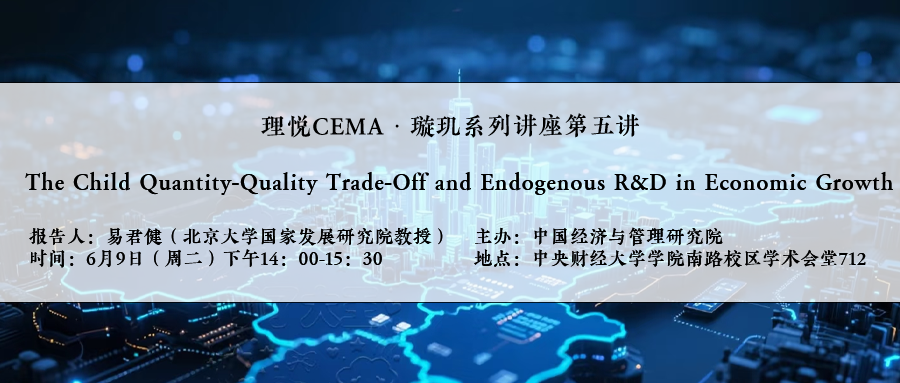
理悦CEMA•璇玑系列讲座第五讲将于6月9日(周二)下午14:00-15:30在学术会堂712会议室举行,由北京大学国家发展研究院易君健教授报告论文“The Child Quantity-Quality Trade-Off and Endogenous R&D in Economic Growth”(经济增长中的子女数量 - 质量权衡与内生研发)欢迎广大师生(尤其科研有兴趣和追求的本科生、硕士生和博士生)参加。讲座对所有人开放,不需要提前预约。
题目
The Child Quantity-Quality Trade-Off and Endogenous R&D in Economic Growth
(经济增长中的子女数量 - 质量权衡与内生研发)
报告人
易君健
北京大学博雅特聘教授;国发院经济学教授、学术委员会主任,未来经济研究中心主任;中国家庭追踪调查(CFPS)共同主持人;同时担任《经济学》(季刊)执行主编和Journal of Health Economics共同主编。他的研究兴趣主要集中于医疗与健康经济学、人工智能经济学、人力资本理论、劳动和人口经济学、发展经济学、计量经济学和行为经济学。他的科研成果先后发表于经济学、管理学、人口学、公共卫生等领域内的国际顶级学术期刊,包括3篇top five: Journal of Political Economy(2篇)、Review of Economic Studies,以及国际一流的International Economic Review、Review of economics and Statistics(2篇), JEEA,Economic Journal, Journal of Labor Economics(3篇),Management Science、Demography、Lancet和Proceedings of National Academy of Sciences(2篇)等。
摘要
This paper develops a growth model integrating price-determined child quantity-quality trade-off with endogenous R&D to examine the long-term relationship between population dynamics and economic growth. Technological progress affects the wage premium for human capital relative to wage of unskilled labor, which parents interpret as a price signal when choosing between fertility and child human capital investment. These decisions shape population growth and human capital supply, creating feedback effects on R&D incentive and thus technological progress. The resulting equilibrium features four development phases: Malthusian, prosperous, aging, and potentially stagnating. Our model uniquely predicts that the interaction between price-determined quantity-quality trade-offs and endogenous R&D inevitably generates population aging through a negative feedback loop: Population growth boosts R&D, raises human capital premiums, reduces fertility, and slows future population growth until population size ultimately begins to shrink. The framework yields distinctive policy implications: Well-designed population policies can prevent aging and sustain growth, while pro-R&D industrial policies may unintentionally depress fertility and undermine long-run growth.
本文构建了一个增长模型,将价格决定的子女数量 — 质量权衡与内生研发相结合,旨在考察人口动态与经济增长之间的长期关系。技术进步会改变人力资本相对非熟练劳动的工资溢价,该溢价会作为价格信号,影响家庭在生育数量与子女人力资本投资之间的决策。这些家庭选择决定了人口增长与人力资本供给,进而对研发激励形成反馈,最终影响技术进步。模型均衡呈现四个发展阶段:马尔萨斯阶段、繁荣阶段、老龄化阶段及潜在停滞阶段。本文模型的独特结论是:价格决定的数量 — 质量权衡与内生研发的相互作用,会通过负向反馈机制必然引发人口老龄化 —— 人口增长推动研发投入、抬升人力资本溢价、压低生育率,最终导致人口增速放缓直至人口规模萎缩。研究框架还提出差异化政策启示:合理的人口政策可延缓老龄化、维持经济增长,而偏重研发的产业政策可能意外抑制生育率,损害长期增长潜力。
时间
6月9日14:00-15:30
地点
学术会堂712
活动对象
创新发展学院师生
主办单位
创新发展学院
中国经济与管理研究院
撰稿:易君健
审稿:何其春
编辑:沈嘉怡
审核:赵扶扬